


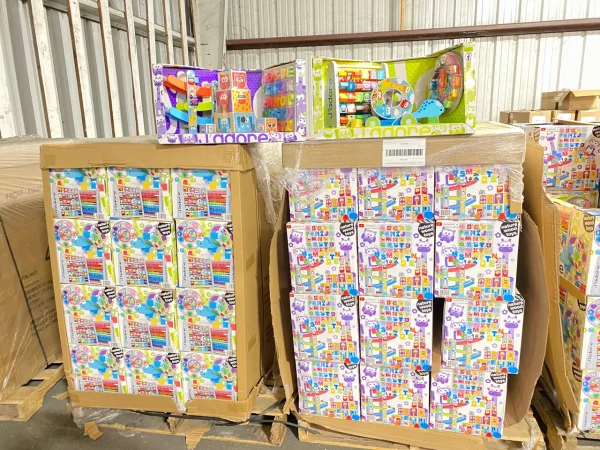
Jadore Wooden Toys Liquidation Pallet
$488.00
One pallet of toys and games. $488 delivered. Sold as-is. Nothing is tested or graded first.
One pallet of toys and games, priced at $488. No piece count is stated on this listing and none will be invented: loads of this class are published at roughly 100 to 400 pieces, which is the estimate to plan against.
The pallet is unmanifested and sold as-is: no itemised list exists at any stage, nothing has been inspected or graded first, and the photograph represents the class rather than your pallet. Some of it is typically new or still tagged; the remainder is returned stock in varying condition.
What is in this pallet
Typical contents:
- Preschool and infant toys
- Dolls, figures and playsets
- Building sets and blocks
- Board games, puzzles and cards
- Plush and soft toys
- Outdoor and ride-on toys
- Arts, crafts and activity sets
- Licensed character lines
Toys are bulky for their value. Boxes are frequently crushed, opened or resealed, and box condition drives what a toy sells for. No brand, licence or age-band split is selected, and the mix rotates with every intake.
What this pallet costs per unit
This pallet is $488. No piece count is published for it, because the quantity is approximate and we will not state a number we cannot stand behind.
No estimated retail value and no expected resale figure are published for this lot. What the price does not cover, and what you need to budget for yourself:
- The hours spent sorting, testing where testing applies, cleaning and photographing
- The selling fees on whichever channel you use
- The share that will never sell, and what it costs to dispose of it
- Storage until the load clears: once unwrapped and spread for sorting, a standard pallet takes up about the footprint of a car parking space, and more while the tiers are laid out.
Where toys and games stock sells
- Facebook Marketplace and local parent groups
- eBay, for sealed and collectible lines
- Bin stores and market stalls
- Whatnot and live selling
Sell-through is rarely even: the strongest pieces clear first, the middle takes as long as you keep listing it, and the tail only moves bundled or flat-priced.
Condition: as-is and uninspected
Toys clear heavily as post-season stock and gift returns, and the first quarter of the year is the peak season for this class because of post-holiday returns. Crushed boxes, opened packs and missing pieces are the defining faults. Working this stock usually means:
- Separate sealed from opened on the first pass — box condition is most of the price
- Check multi-piece sets for completeness
- Check for recalls on anything you intend to resell
- Test battery-operated toys
Published industry guidance puts the unsellable share at roughly 1 to 5% on shelf pulls and overstock and 20 to 40% on customer returns, with 10 to 25% typical across a mixed load of this kind. Those figures describe the class, not a projection for your pallet.
Stock at this scale exists because of the volume of retail returns: National Retail Federation research estimates that US shoppers returned $849.9 billion of merchandise in 2025, around 15.8% of everything bought, and returned stock has to be cleared somewhere.
Most problems with this class are avoidable: mixing sealed and opened stock on the first pass, listing multi-piece sets without counting them, or skipping the recall check on children’s products.
Who buys this pallet
- Resellers working parent and family markets
- Bin store and market-stall operators
- Live sellers
It is the wrong purchase if you need sealed collectible stock, or cannot check completeness or recalls.
Questions
Will sets be complete?
Not always. Check multi-piece sets before listing them as complete.
Should I check recalls?
Yes. Checking recall status on children’s products before resale is your responsibility.
How many pieces will I get?
No count is stated for this load. Published guidance puts this class at roughly 100 to 400, which is an estimate to plan against, not a promise.
Is there a manifest for this lot?
No. No itemised list of this lot’s contents exists at any stage. Everything known before the pallet is opened is the class of goods and the condition basis set out above.
Can I choose what is in it?
No. Nothing is selected, substituted or held back. A load is whatever the source channel cleared, which is why it is priced by the pallet rather than by the line.
Be the first to review “Jadore Wooden Toys Liquidation Pallet”
Related products

Toys, Kids & Baby
Toys, Kids & Baby

Toys, Kids & Baby

Toys, Kids & Baby

Toys, Kids & Baby

Toys, Kids & Baby

Toys, Kids & Baby

Toys, Kids & Baby
Reviews
There are no reviews yet.