


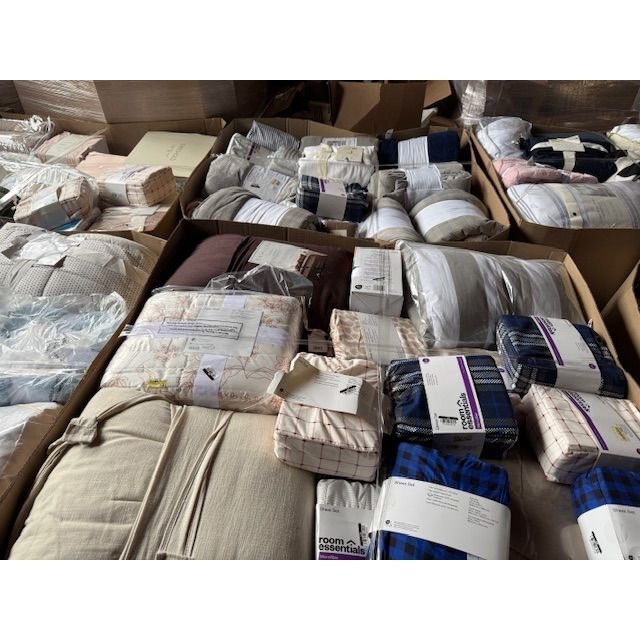
Target Home & Kitchen Truckload
$7,500.00
A full truckload of home and kitchen. Target stock. $7,500 delivered. Sold as-is. Nothing is tested or graded first.
A full truckload of home and kitchen goods from the Target clearance channel, priced at $7,500. No piece count is published for this listing: loads of this class are generally reckoned at roughly 100 to 400 pieces, and that range is an estimate to plan around rather than a promise. The truckload is unmanifested and sold as-is — nothing is opened, tested or graded, no itemised list exists, and the photograph shows the class of load rather than the exact load you would receive. Part of a typical load is new or still tagged; the rest is returned stock whose condition varies piece to piece.
What’s in this truckload
Home and kitchen loads mix bulky boxed goods with soft textiles, so piece counts vary widely for the same pallet footprint. No category or colour split is chosen — a load is defined by the source retailer’s clearance, not by a picked assortment. Typical contents:
- Cookware, pans and bakeware
- Dinnerware, glassware and cutlery
- Kitchen tools and gadgets
- Storage and organisation
- Bedding, sheets and pillows
- Bath, towels and shower items
- Home décor, frames and candles
- Rugs, curtains and soft furnishings
The mix changes with every intake — contents and brands differ from one order to the next, and nothing is picked out, swapped or withheld.
What this truckload costs per unit
The truckload is $7,500. No count is published because the quantity is only approximate, and we will not print a figure we cannot stand over. No estimated retail value or expected resale return is published for this lot either. The price also leaves several costs with you:
- The hours spent sorting, testing where testing applies, cleaning and photographing
- Fees on whichever channel you sell through
- The share that never sells, and what it costs to dispose of it
- Storage until the load clears — a truckload is a warehouse commitment, not a garage one. Work out where every pallet will stand before you order, and how you will move them without a dock
Condition: as-is and uninspected
Housewares clear as seasonal resets, discontinued lines and returns. Breakage and incomplete sets are the defining faults: glass and ceramics do not survive returns handling well. When you work the load:
- Unpack glass and ceramics carefully and expect breakage
- Check sets are complete before listing them as sets
- Launder textiles before resale
- Bundle odd pieces rather than listing them singly
Published industry guidance puts the unsellable share at roughly 1 to 5% on shelf pulls and overstock and 20 to 40% on customer returns, with 10 to 25% typical across a mixed load of this type. Those are class figures, not a projection for your load. Stock like this exists at scale for one reason: National Retail Federation returns research estimates US shoppers sent back $849.9 billion of merchandise in 2025, about 15.8% of everything they bought, and returned stock has to go somewhere. Buyers who end up disappointed have usually unpacked glass and ceramics carelessly, listed a set as complete without counting it, or resold textiles unlaundered.
Where home and kitchen stock sells
- Facebook Marketplace and local sale, for bulky goods
- Bin stores and discount racks
- eBay, for branded cookware and sets
- Market stalls
Sell-through is rarely even: the strongest pieces clear first, the middle takes as long as you keep listing it, and the tail only moves bundled or flat-priced.
Who buys this truckload
Local resellers who can move bulky goods, bin store and discount-rack operators, market-stall sellers, and home-staging and landlord supply buyers. It is the wrong purchase for buyers who need complete matched sets, and for sellers with no space for bulky mixed goods.
Questions
Should I expect breakage?
Yes. Glass and ceramics do not travel well through returns handling.
Are textiles clean?
Not necessarily. Launder textiles before resale.
How many pieces will I get?
No piece count is stated for this load. Published guidance puts the class at roughly 100 to 400 pieces — an estimate to plan against, not a promise.
Is there a manifest for this lot?
No. No itemised list of its contents exists at any stage. What is described here is the class of goods and the condition basis, which is everything known before the load is opened.
Can I choose what is in it?
No. Nothing is selected, substituted or held back. A load is whatever the source channel cleared, which is why it is priced the way it is.
Be the first to review “Target Home & Kitchen Truckload”
Related products
Apparel & Clothing

Target Liquidation

Apparel & Clothing

Apparel & Clothing

General Merchandise & Mystery Boxes
Target Liquidation

General Merchandise & Mystery Boxes

Target Liquidation
Reviews
There are no reviews yet.